
How I Fell in Love with Russian Holidays — And Why You Will Too
Hi there!
My name is Katy Jones. I am an aspiring writer but my full time job is a teacher of young children in a private school in one of the wealthy Moscow suburbs. Originaly from Melbourne, I have lived in Russia for more than a year now. When I was getting ready to come here, my friends were giving me a weird look and say “Are you serious? To a country where it’s winter for half the year, and the rest of the time… well, it might still snow?” And I replied, “Have you seen how they know how to celebrate here?” Now they’re totally jealous — because I’ve seen with my own eyes how the whole country can simultaneously decide: “Okay, enough with the gloomy stuff, let’s have some fun!”
And you know what’s the best part? In Russia, they don’t hide the party behind closed doors. The celebration spills out onto the streets, takes over the squares, ice rinks, and markets, and every passer‑by automatically becomes part of it. Even if you’re standing there looking a bit lost, wondering, “What on earth is going on?”, someone will immediately shove a hot drink into your hands, drag you into a folk circle dance, and tell you exactly where to go for the tastiest pancakes. At least that has been my experience as an expat here.
I could go on and on about what drew me to this country and why I’m still here, but I’m afraid the article would end up as long as a short novel — and no one would read it to the end. So today I’ll share my absolute favourite thing: the holidays. I’ll tell you about three major celebrations that are totally worth experiencing in person. Not to sit on the sidelines pretending to be this cool, detached observer, but to dive right into the thick of it: try everything, laugh, perhaps embarrass yourself a bit like I did, and take home not just a fridge magnet, but real, live emotions that’ll keep you warm for a long time.
Picture this: you step outside in late December. The frost nips at your cheeks, but you don’t have time to get cold — there’s just too much happening around you for the chill to catch up. The city looks like it’s stepped right out of a Christmas fairy tale: twinkling lights everywhere, shop windows all glowing, huge Christmas trees standing proudly in the squares, and markets bustling underneath them. You’re walking along, shivering a little in the wind, and suddenly someone presses a mug of hot mulled wine into your hands. Ok on a serious note – don’t take drinks from strangers! The air smells of cinnamon, gingerbread, and mandarins — and that scent seems to sink right into your scarf, your coat, your hair, so that you walk around smiling for the next week, because it keeps reminding you: a miracle is coming.
My first time at one of those city‑centre ice rinks was something else. All ages were out there: kids zipping around and nearly knocking everyone over, teens trying to look like pro figure skaters, and grandparents gliding slowly but confidently across the ice, laughing at their own little slip‑ups. And no one gets mad! Coming from Australia, ice skating isn’t exactly my forte. That’s the heart of it: New Year’s here is all about being together. It’s about feeling like you belong, even with a stranger.
And December 31st… You might think you know what a holiday is. But here, it’s not just dinner and the chimes marking midnight. It’s a full‑on ritual, and you’re invited to be part of it. In the city centre, there are street parties, concerts, hosts getting the crowd all fired up, and everyone counting down the seconds to midnight together. When the clock strikes twelve, it feels like the whole city holds its breath for a split second — and then explodes with shouts of “Hurray!”, hugs, and congratulations. You stand there in the crowd, strangers clap you on the shoulder, yell, “Happy New Year!” and suddenly you realise: you’re a part of something special.
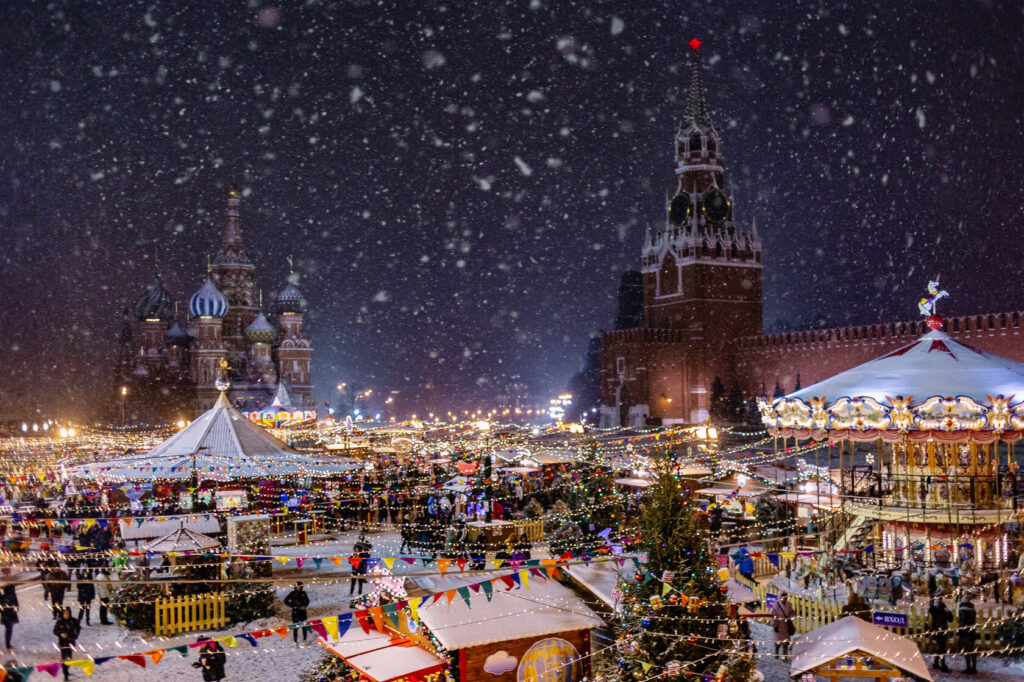
Then the holidays begin — and that’s when the real fun starts. Don’t stay indoors: get out, go beyond the city, immerse yourself in the atmosphere. I went to villages in the Moscow region where they throw proper folk festivals: sleigh rides pulled by horses, icy slides where you zoom down screaming with joy because the speed literally takes your breath away.
Plus, there are workshops: you can make gingerbread cookies, paint matryoshka dolls, learn how to lead a traditional circle dance (which, by the way, is not as easy as it looks — you’ve got to keep the rhythm and not get tangled up in everyone’s arms!). And food — so much food! Olivier salad, herring under a fur coat, dumplings, pies… You’ll think you’re about to burst, but every time someone offers you another bite, you just can’t say no. I will admit i had to work extra hard in the gym in January!
By the way, if you want to experience New Year’s in a truly homely way, try to get invited to a local family’s dinner. Yes, it sounds bold, but in Russia it’s not that impossible: if you show genuine interest in the traditions, people are happy to share their holiday. I once met a family at the ice rink; we laughed together at my clumsy attempts not to fall, and then they invited me over. It turned out to be the best New Year’s ever: not flashy, not glossy, but real. With stories about childhood, with jokes, with that special feeling that you’re not just a guest, but almost family.
Another important thing: in Russia, New Year’s is not only about the big fun — it’s also about coziness. While the city outside is all frost and fairy lights, inside there’s the smell of a Christmas tree, hot tea, and fresh baking. This contrast — between the cold city and the warm home — is what makes the holiday special. If you’re a tourist, don’t be afraid to look for that coziness: pop into a small café that smells of pies, sit by the window, and watch the snowy streets. Or find a “warm” spot like a museum, library, or bookstore, where you can just take a break from the cold and feel how the city lives.
Now, a few practical tips about transport if you plan to travel around Moscow and the Moscow region during the holidays. In the city centre on New Year’s Eve, many streets are closed for celebrations, so it’s a good idea to check the routes in advance and maybe park your car a bit farther away and walk the rest of the way. The metro and the MCC run longer than usual, which is a lifesaver: you can keep enjoying the festivities without worrying about how to get home. If you’re heading to the Moscow region, the commuter trains do run, but the schedule might change, so check it ahead of time. One more tip: download a maps and public transport app — it’s incredibly helpful, especially when you’re standing in the cold trying to figure out where to go.
Then comes Maslenitsa — and you realise that winter doesn’t just slip away here; it leaves with a bang. It’s not just “oh, the snow’s melting”; it’s a whole week where everyone says goodbye to the cold. And they do it with joy, noise, and pancakes.
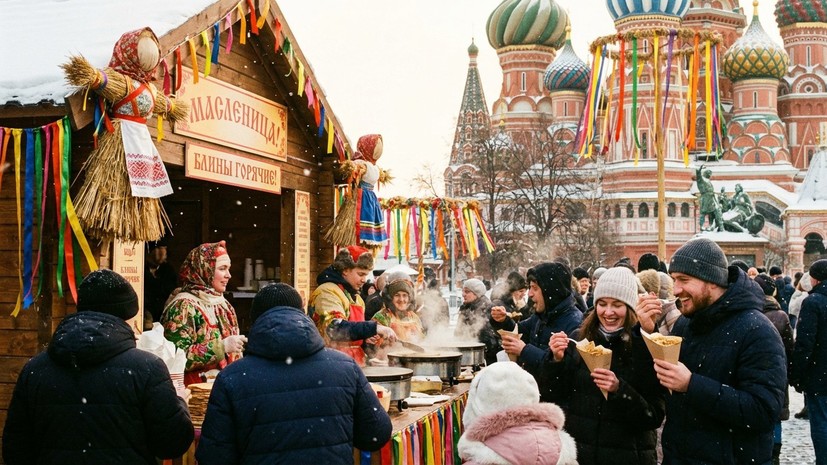
Blini, pancakes, little pancake things — they call them all sorts of names here, but the point is the same: there are loads of them, and you can wrap anything your heart desires inside. You can try blini with caviar, honey, sour cream, jam, mushrooms, herring — yes, herring! And you know what? They’re delicious. People here aren’t afraid to mix flavours, and that’s awesome.
During Maslenitsa, the city squares turn into one giant stage. Folk ensembles perform on the stage, singing traditional songs, and everyone around joins in, even if they don’t know the words. They organise contests: who can climb a pole the fastest, who can throw a felt boot the farthest, who can sing a chastushka best. You don’t have to climb the pole (though it’s its own special kind of adrenaline rush), but you absolutely must try throwing a boot. Hitting the target is a whole new level of pride. And at the end of the day comes the grand finale: they burn the Maslenitsa effigy. And it’s not just “lighting a doll on fire.” It’s symbolic: winter is leaving, spring is coming, everything bad burns away in the flames, and ahead lies light and warmth.
Interestingly, Maslenitsa looks different in various regions. Some places focus on theatrical performances, others on sports games, and some make the market and blini the main attraction. In the Moscow region, for example, some spots set up entire “Maslenitsa villages” with wooden houses, workshops, rides, and even mini‑zoos where you can see reindeer or horses. If you get the chance, try visiting a few different places — you’ll see how the same tradition can sound so different depending on the location.
There’s also another layer to Maslenitsa: it’s not only about food and fun, it’s also about forgiveness. On the last day of the week, people traditionally ask each other for forgiveness for any grievances, even the small ones. It might sound unusual, but in the festive atmosphere, it doesn’t feel heavy — it’s more like a way to clear your soul before spring. When a stranger says to you, “Forgive me if I’ve done anything wrong,” and you reply, “God forgives, and I forgive,” there’s something very bright and light about it.
Just when you think you’ve seen every kind of celebration possible, March rolls around. And March 8th here is a whole different story. You’re probably thinking, “Okay, flowers, chocolates, cards — what’s so special about that?” But here, it’s an entire day when the city seems to tell women: “You’re the most important.” In the morning, the streets are full of men carrying armfuls of tulips and mimosa. They’re a little nervous, smiling, sometimes mixing up the flowers, but they do it with all their heart. And the women — they seem to glow that day. Not because they got a present, but because they feel truly appreciated.
As you walk around the city, you’ll see men helping women carry bags, holding doors open, giving up their seats on public transport. To be honest, Russian man are usually like this every day of the year. Men in my home country undoubtedly lose out in thr gentleman rating! Restaurants roll out special menus, deck themselves out with decorations, and musicians play something soft and lovely. Squares host concerts, workshops, and markets. And the coolest part? Families come together for this. Dads and sons give homemade cards to their moms and sisters, kids recite poems, and grandmas sit on benches smiling like it’s the happiest day of the year.
And you suddenly get it: March 8th here isn’t about “you’re pretty, here’s a flower.” It’s about gratitude. It’s about saying, “Thank you for being here, for making the world a better place.” And that feeling is contagious. You’ll soak up so much warmth that day that you’ll feel like you could warm up the entire world.

Transport and logistics on March 8th are also worth planning ahead. The city centre can get really crowded, so it’s best to avoid rush hours and build some extra time into your route. The metro, MCC, and central streets will be busy, but that’s part of the atmosphere: you get to see the city celebrating.
Now, about souvenirs. If you want to take something home that’s more meaningful than a fridge magnet, look for items with history and character. A matryoshka is a classic, but choose one with interesting painting rather than the simplest design.
Gingerbread cookies aren’t only tasty — they’re also beautiful: decorated with icing, shaped like houses, Christmas trees, or animals.
Textiles with folk patterns — scarves, towels, napkins — are both lovely and practical. You can also pick up a jar of honey, jam made from northern berries, or herbal tea — these are little pieces of Russian atmosphere that will remind you of your trip.
As I tell these stories, I relive every single moment — and I realise that if you come here for even just one of these holidays, you won’t just be “observing traditions.” You’ll plunge right into them. You’ll taste blini straight from the pan while they’re still hot, ride in a horse‑drawn sleigh, join the contests, watch the Maslenitsa effigy go up in flames, feel the city breathe as one at the stroke of midnight on New Year’s Eve. You’ll meet people who’ll smile at you for no reason other than the fact that a holiday is a perfect excuse to share joy.
Sure, it can get cold here. But when there’s so much warmth around — from the people, from the atmosphere, from the celebration itself — the frost doesn’t stand a chance. In fact, it sharpens the experience: you feel even more how good it is to warm up with a hot drink, how wonderful it is to be hugged, how sweet the scent of a fresh pancake can be.
So if you’re looking for a place where a holiday is a shared adventure, where no one will leave you out, but will gladly pull you into a circle dance or offer you a warm pie — Russia is waiting for you. Come for New Year’s, Maslenitsa, or March 8th, and become part of this incredible atmosphere. You’ll leave with a suitcase full of memories, a ton of photos, and a firm intention to come back again.